
Study Summary: Phase 1
Military Aviators Cancer Study (MACS) Phase 1
Study Summary: Phase 1
Phase 1 of the Study of Incidence of Cancer Diagnosis and Mortality Among Military Aviators and Aviation Support Personnel was a retrospective cohort study performed to determine whether there was a higher incidence of cancer among military aviators and aviation support personnel than in the general U.S. population. Military health records and cancer data were examined for 156,050 aircrew and for a further 737,891 groundcrew; the records were compared to the U.S. population using the Surveillance, Epidemiology, and End Results Program (SEER) as a reference population. Phase 1 of the study was conducted in two parts: Part 1A included only DoD cancer data and evaluated all 156,050 aircrew and 737,891 groundcrew; Part 1B included VA and state registry cancer data in addition to DoD data. However, Part 1B was restricted to 138,505 aircrew and 659,825 groundcrew because individuals with a home of record for a state that did not have cancer registry data included in the study were excluded.
Cancer data for both the military and SEER populations were examined for the surveillance period of January 1, 1992, through December 31, 2017. All types of malignant cancer diagnoses were included in the study: additionally, 12 cancer sites were analyzed for their separate effects.
The study was requested in response to Section 750(a)(2)(B) of the William M. Thornberry National Defense Authorization Action Act for Fiscal Year 2021.
Study Population
Current and former aircrew and groundcrew were identified using Duty Military Occupations Specialty codes (DMOS) in the Defense Medical Surveillance System (DMSS). Individuals were included in the study population if the following two conditions were met:
- They had an occupation code listed in the DMSS that indicated they were either aircrew or groundcrew.
- They were in military service or had an inpatient or outpatient medical encounter at a military treatment facility between 1992 and 2017.
Example of Service Members (SMs) included and not included in the military study population
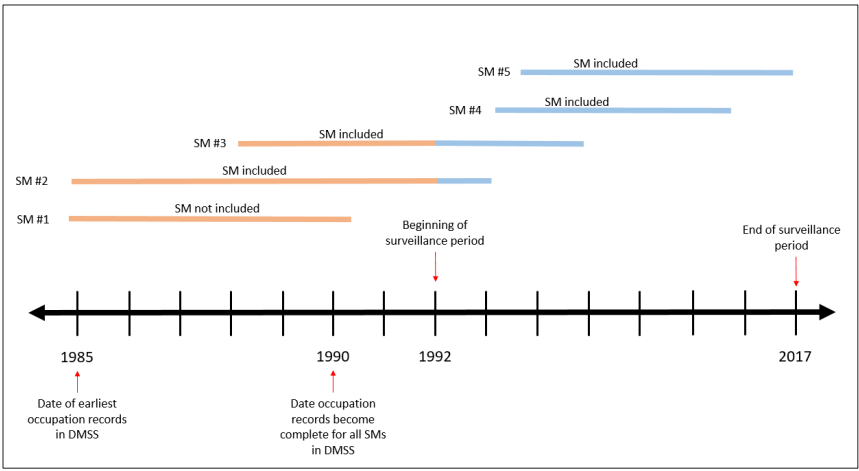
Subject matter experts and Service representatives selected the DMOS codes used to distinguish aircrew and groundcrew. DMOS codes specific to remotely piloted aircrafts and helicopters were excluded from the study population. Individuals were classified as aircrew if they met either of the following two conditions:
- They spent at least 3 years of military service in an aircrew DMOS (not including training time).
- They had less than 3 years of military service in an aircrew DMOS (not including training time), but it represented the greatest fraction of their overall service time. (e.g., they spent 2 years in an aircrew occupation, 1.5 years in a ground crew occupation, and 1 year in other occupations)
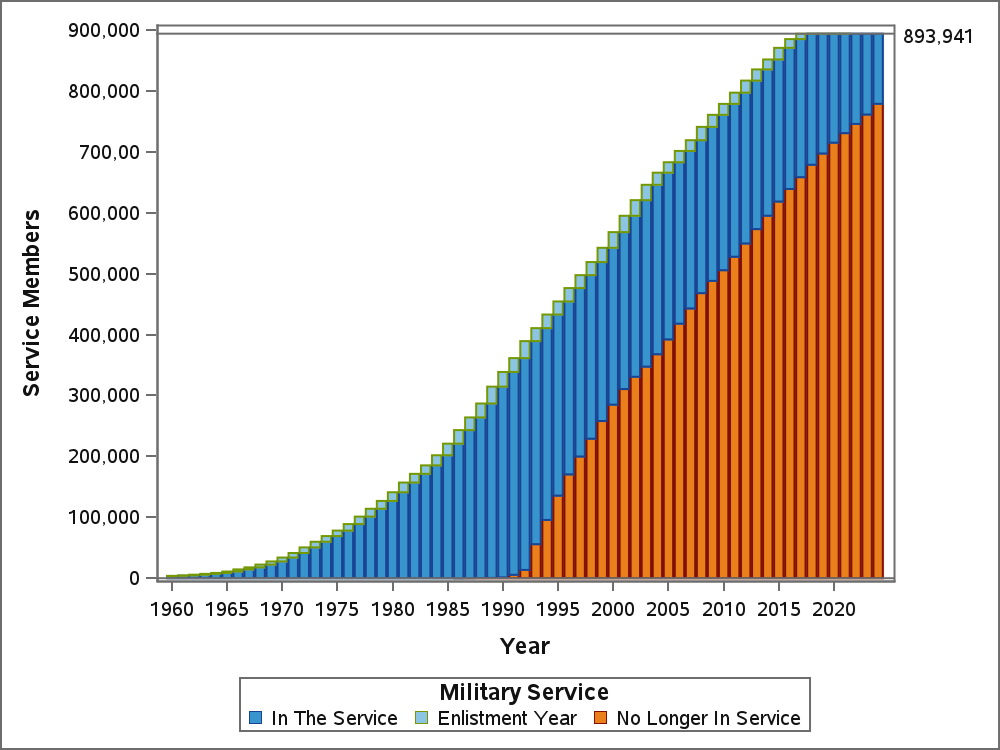
Accumulation of Service Members into the MACS cohort, by enlistment year
Results of the Study
Results of Phase 1B are included over Phase 1a because they include the state cancer registry matching. After adjusting for age, sex, and race/ethnicity, aircrew members had statistically higher incidence of cancer diagnoses of all sites (by 15 percent), melanoma (by 75 percent), thyroid (by 31 percent), and prostate (by 20 percent), compared to individuals in the U.S. population. Incidence of cancer diagnoses of the colon and rectum, urinary bladder, kidney and renal pelvis, pancreas, and lung and bronchus were statistically lower compared to individuals in the U.S. population by 38 percent, 30 percent, 17 percent, 17 percent, and 63 percent, respectively. There was not a statistically significant difference between aircrew members and members of the U.S. population for cancers of the testis, brain and nervous system, non-Hodgkin lymphoma, and female breast.
| Cancer Site | Person-years | Observed cases | Expected cases | SIR | 95% LL | 95% UL | p-value |
|---|---|---|---|---|---|---|---|
| All sites | 2,832,855 | 10,489 | 9,158 | 1.15 | 1.12 | 1.17 | <.0001 |
| Colon and rectum | 2,908,259 | 557 | 898 | 0.62 | 0.57 | 0.67 | <.0001 |
| Pancreas | 2,911,547 | 173 | 209 | 0.83 | 0.71 | 0.96 | 0.0122 |
| Melanoma | 2,899,634 | 1,334 | 764 | 1.75 | 1.65 | 1.84 | <.0001 |
| Prostate | 2,741,047 | 2,784 | 2,320 | 1.20 | 1.16 | 1.25 | <.0001 |
| Testis | 2,755,683 | 279 | 297 | 0.94 | 0.83 | 1.06 | 0.3133 |
| Urinary bladder | 2,909,535 | 341 | 484 | 0.70 | 0.63 | 0.78 | <.0001 |
| Kidney and renal pelvis | 2,909,789 | 337 | 407 | 0.83 | 0.74 | 0.92 | 0.0004 |
| Brain and nervous system | 2,910,843 | 211 | 214 | 0.99 | 0.86 | 1.13 | 0.8958 |
| Thyroid | 2,908,845 | 303 | 232 | 1.31 | 1.16 | 1.46 | <.0001 |
| Non-Hodgkin lymphoma | 2,908,216 | 492 | 535 | 0.92 | 0.84 | 1.01 | 0.0649 |
| Female breast | 150,614 | 137 | 123 | 1.11 | 0.94 | 1.32 | 0.2225 |
| Lung and bronchus | 2,910,816 | 368 | 1,006 | 0.37 | 0.33 | 0.41 | <.0001 |
| Table taken from Table 2 at Study on the Incidence of Cancer Diagnosis and Mortality among Military Aviators and Aviation Support Personnel from Health.mil | |||||||
Ground crew members had statistically higher incidence of kidney and renal pelvis cancer (by 12 percent), compared to individuals in the U.S. population. Ground crew members had statistically lower incidence of cancer diagnoses of the colon and rectum (by 22 percent), pancreas (by 10 percent), melanoma (by 4 percent), testis (by 14 percent), non-Hodgkin lymphoma (by 18 percent), female breast (by 8 percent), lung and bronchus (by 26 percent), and all sites (by 5 percent). There was no statistically significant difference for cancer diagnoses of the prostate, urinary bladder, brain and nervous system, and thyroid.
| Cancer Site | Person-years | Observed cases | Expected cases | SIR | 95% LL | 95% UL | p-value |
|---|---|---|---|---|---|---|---|
| All sites | 12,275,116 | 29,415 | 30,921 | 0.95 | 0.94 | 0.96 | <.0001 |
| Colon and rectum | 12,463,406 | 2,289 | 2,928 | 0.78 | 0.75 | 0.81 | <.0001 |
| Pancreas | 12,476,844 | 600 | 667 | 0.90 | 0.83 | 0.98 | 0.0094 |
| Melanoma | 12,458,919 | 2,252 | 2,351 | 0.96 | 0.92 | 1.00 | 0.0416 |
| Prostate | 11,361,610 | 7,105 | 7,048 | 1.01 | 0.98 | 1.03 | 0.5028 |
| Testis | 11,396,474 | 1,046 | 1,211 | 0.86 | 0.81 | 0.92 | <.0001 |
| Urinary bladder | 12,468,845 | 1,363 | 1,415 | 0.96 | 0.91 | 1.02 | 0.1725 |
| Kidney and renal pelvis | 12,469,221 | 1,474 | 1,314 | 1.12 | 1.06 | 1.18 | <.0001 |
| Brain and nervous system | 12,474,084 | 716 | 741 | 0.97 | 0.90 | 1.04 | 0.3765 |
| Thyroid | 12,469,737 | 892 | 874 | 1.02 | 0.96 | 1.09 | 0.543 |
| Non-Hodgkin lymphoma | 12,466,542 | 1,500 | 1,832 | 0.82 | 0.78 | 0.86 | <.0001 |
| Female breast | 1,061,428 | 763 | 826 | 0.92 | 0.86 | 0.99 | 0.0281 |
| Lung and bronchus | 12,472,065 | 2,361 | 3,197 | 0.74 | 0.71 | 0.77 | <.0001 |
| Table taken from Table 3 at https://health.mil/Reference-Center/Reports/2024/05/09/Study-on-the-Incidence-of-Cancer-Diagnosis-and-Mortality | |||||||
In addition to the 12 cancer sites selected for separate analysis, other cancers are available through the DMSS claims data and tumor registries. Those cancers were included in the All Sites analysis, and may be requested by investigators for analyses.
Please see CDAS Cancers website for further information on cancers in the MACS cohort.