Deployment Assessments
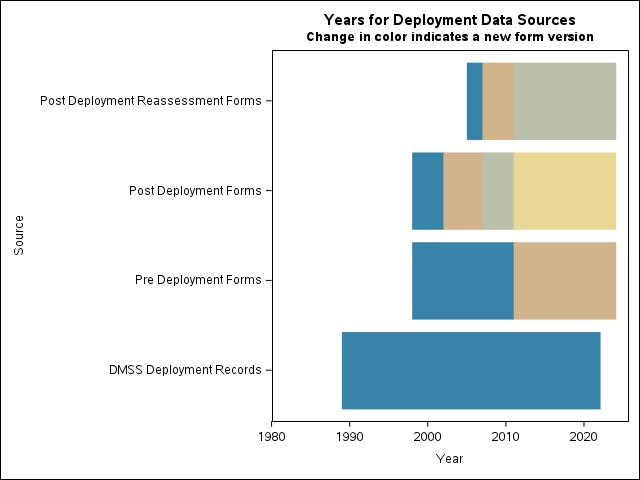
Beginning in 1999 a protocol was introduced to assess the physical and mental health of service members before and after deployments. Starting that year, Pre-Deployment Health Assessments (form DD-2795) and Post-Deployment Health Assessments (form DD-2796) were given to military personnel to assess areas of interest, including general health concerns, physical ailments prior to and during deployment, hazardous exposures (chemicals, radiation, and environmental), and health screenings (alcohol abuse, depression, PTSD, risk of suicide, and others). In 2005 a Post-Deployment Re-assessment (form DD-2900) was developed to document the resolution or continuation of physical and mental health problems of service members post-deployment; widespread rollout of the re-assessment began in 2006. Following an update in 2012, mental health assessments (form DD-2978) were added to the protocol to screen for PTSD, depression, and other conditions. Whenever possible, assessments have been linked within the database with their respective deployments.
Administrative Protocol
| Form | Completion Date Protocol |
|---|---|
| Pre-Deployment Health Assessment | No earlier than 120 days before the start of deployment |
| Post-Deployment Health Assessment | No later than 30 days after return from deployment |
| Post-Deployment Re-assessment | 90-180 days after return from deployment |
| Mental Health Assessment 1 | 6-18 months after return from deployment* |
| Mental Health Assessment 2 | 18-30 months after return from deployment* |
Form Changes
The assessment forms have undergone several changes since their inceptions. The initial pre-deployment form was expanded from a 2-page survey on overall physical and mental health to include risks (e.g., alcohol and suicide) and expanded medical referral information. Expansive changes were also made to the post-deployment assessments and post-deployment re-assessments, with revisions to what exposures were being assessed, and the inclusion and removal of several questionnaire sections.
Assessments
Pre-Deployment Form (DD-2795)
The pre-deployment form was initially intended to assess general readiness for deployment. The questions aimed to determine how service members broadly felt about their current physical and mental health, and whether they had their necessary medical equipment (e.g., glasses, medications). After completing the self-assessment, service members met with a health provider who conducted an interview, provided medical referrals, and made a final determination of deployability. The form was expanded substantially in 2012 to include behavioral risk assessments and screening for mental health concerns (e.g., suicide and PTSD).
| Questionnaire Section | 1999 Version | 2012+ Versions |
|---|---|---|
| Deployability Status | Yes | Yes - expanded |
| Military Service (branch, component, grade) | Yes | Yes |
| Deployment Location (country) | Yes, multiple choice | Yes, plain text |
| General Physical and Mental Wellbeing | Yes | Yes |
| Medical Referrals | Yes | Yes* |
| Tobacco Usage | No | Yes |
| Alcohol Questionnaire (AUDIT-C) | No | Yes |
| Mental Health Assessments (Depression, PTSD, Life Stressors) | No | Yes |
| Suicide Risk Evaluation | No | Yes |
| Medical Reviewer Concerns | No | Yes |
Post-Deployment Form (DD-2796)
The purpose of the post-deployment form is to assess the physical and mental health condition of service members returning from deployment. The assessment aims to determine how the service member’s health may have changed during the deployment, identify ongoing medical issues, catalog treatments and medical referrals, and identify potential hazardous exposures.
The initial 1999 version of the form asked 6 general questions about service members’ general health and mental wellbeing, with spaces to detail concerns about possible exposures and health concerns. The form was revised in 2003 to include a self-assessment questionnaire with questions about specific situations, lists of possible exposures, and health concerns; the original questions from the 1999 version were also collected as part of an interview process. In 2008 the form was expanded to include additional sections, and in 2012 it was revised again to modify language and add questions within several sections. Form revisions changed which risks and exposures were assessed and asked for further clarification as to the severity of certain conditions experienced during the deployment.
| Section | 1999 Version | 2003 Version | 2008 Version | 2012+ Versions |
|---|---|---|---|---|
| Military Service (branch, component, grade) | Yes | Yes | Yes | Yes |
| Deployment Location | Yes | Yes | Yes | Yes |
| Physical Wellbeing and Symptoms | Yes, Free Text | Yes | Yes | Yes* |
| Mental Health Screenings (Depression, PTSD, Life Stressors) | No | Yes | Yes | Yes* |
| Medical Treatments | No | Yes | Yes | Yes* |
| Exposures (e.g., Chemicals, Pollutants, Radiation) | Yes, Free Text | Yes | Yes* | Yes* |
| Medical Reviewer Concerns | Yes | Yes | Yes | Yes |
| Medical Referrals | Yes | Yes | Yes | Yes |
| Alcohol Questionnaire (AUDIT-C) | No | No | Yes | Yes |
| Post-Deployment Health Concerns | No | No | Yes | Yes |
| Suicide Risk Evaluation | No | No | Yes | Yes* |
| Tobacco Usage | No | No | No | Yes |
Post-Deployment Re-assessment (DD-2900)
Continued health monitoring is performed after service members return from deployment. The re-assessment form contains the same sections as the post-deployment assessment, but questions more directly relate to how service members feel their symptoms relate to their deployments, and how well they are reintegrating upon return. Although the form has been revised several times, the updates primarily consisted of clarification and expansion of the sections originally laid out in the 2005 version.
| Section | 2005 Version | 2008 Version | 2012 Version |
|---|---|---|---|
| Military Service (branch, component, grade, number of deployments) | Yes | Yes | Yes |
| Deployment Location | Yes, bubbles | Yes, plain text | Yes, plain text |
| Deployment-related health concerns | Yes | Yes | Yes |
| Exposures (e.g., Chemicals, Pollutants, Radiation) | Yes | Yes, Expanded | Yes*, plain text categorized by reviewer |
| Mental Health Screenings (Depression, PTSD, Life Stressors) | Yes | Yes | Yes |
| Family Relationship Concerns | Yes | Yes | Yes |
| Alcohol Screening | Yes (no AUDIT-C) | Yes (AUDIT-C) | Yes (AUDIT-C) |
| Suicide Risk Evaluation | Yes | Yes | Yes |
| Medical Reviewer Concerns | Yes | Yes | Yes |
| Medical Referrals | Yes | Yes | Yes |
| Traumatic Brain Injury Screening | No | Yes | No |
| Combat Experiences | No | No | Yes |
Other Assessments
Starting in 2014 an additional two form collections were added to the deployment assessments cycle. A Mental Health Assessment (form DD-2978) is administered between 6-18 months and again 18-30 months after returning from deployment. These self-assessments exclude sections on physical health and environmental exposures and, instead, deal exclusively with mental health and risk assessment screenings (e.g., alcohol abuse). Note: completion of a periodic health assessment within the protocol window qualifies service members as having completed their MHA for that period because the PHA has the MHA included as part of it. MHA records are not comprehensively captured and processed into the MACS database.
| Section | In DD-2796 (Post-Deployment)? |
In DD-2978 (Mental Health Assessment)? |
|---|---|---|
| Military Service (branch, component, grade) | Yes | Yes |
| Deployment Location | Yes | Yes |
| Physical Wellbeing and Symptoms | Yes | No |
| Mental Health Screenings (Depression, PTSD, Life Stressors) | Yes | Yes |
| Medical Treatments | Yes | No |
| Exposures (e.g., Chemicals, Pollutants, Radiation) | Yes | No |
| Medical Reviewer Concerns | Yes | No |
| Medical Referrals | Yes | No |
| Alcohol Questionnaire (AUDIT-C) | Yes | Yes |
| Post-Deployment Health Concerns | Yes | No |
| Suicide Risk Evaluation | Yes | Yes |
| Smoking Status | Yes | No |
Summary
- Deployment Assessments have been linked to the DOD deployment rosters using the completion date protocols
- Starting in 1999, 40% of all deployments have a Pre-Deployment Assessment link
- Starting in 1999, 41% of all deployments have a Post-Deployment Assessment link
- Starting in 2006, 38% of all deployments have a Post-Deployment Re-Assessment link
- Not all forms could be linked to a deployment. In some circumstances it is noted that the service member is not fit to deploy at that time. In other cases, reported deployment times could not be verified in the DOD rosters
- When analyzing outcomes between deployed personnel and not, there can be a “healthy deployer bias” due to less healthy service members not being sent on deployments
Variables
- See Form Sections for data collection within each of the forms.